
OSHA 10 and OSHA 30 are both training programs offered by the Occupational Safety and Health Administration (OSHA) in the United States. These programs are designed to educate workers about workplace hazards and their rights, as well as to promote safety awareness and compliance with OSHA regulations. However, there are key differences between OSHA 10 and OSHA 30 in terms of the depth of training and the target audience.
Entry level workers who are seeking work in construction industry need the OSHA 10-Hour Construction industry outreach training while professionals seeking work in manufacturing, warehousing, refineries, logistics and power generation need to take the OSHA 10-Hour General Industry Outreach Training.
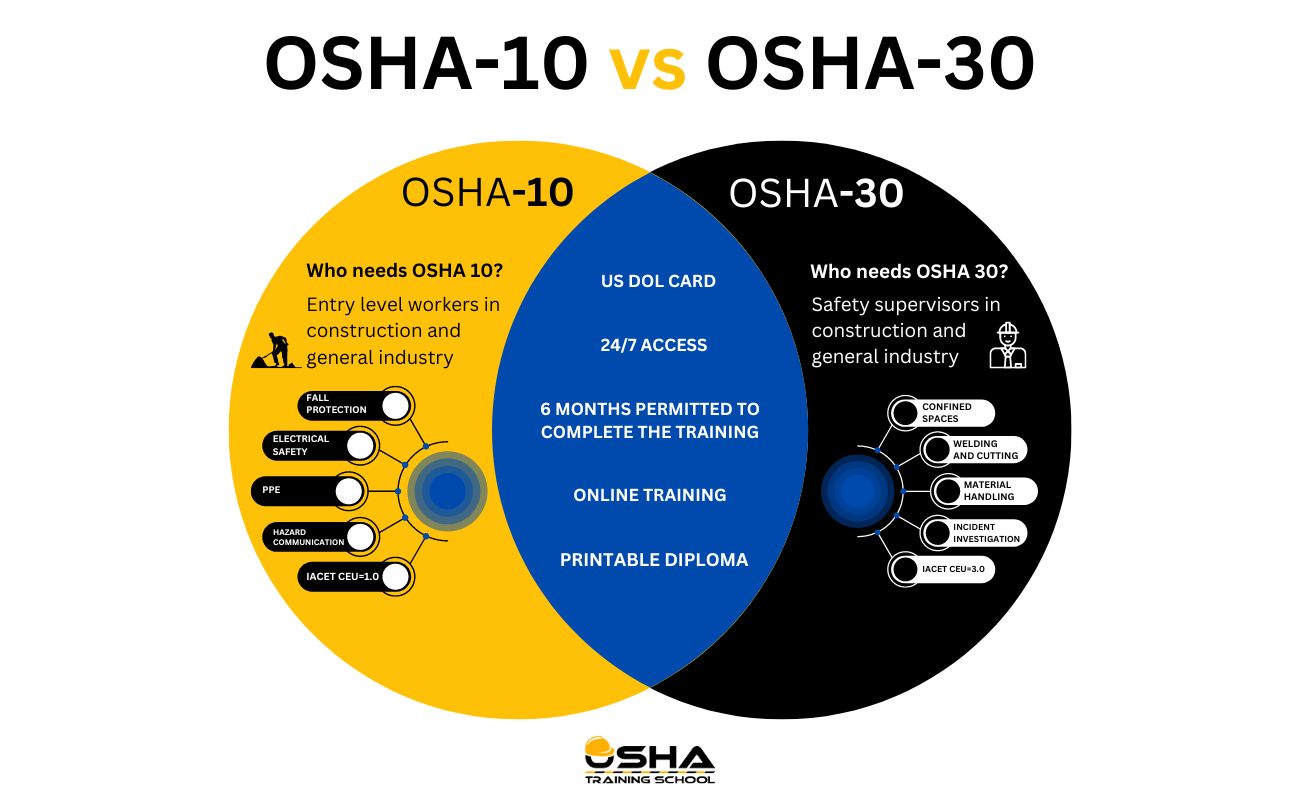
Safety supervisors working in the construction industry need to take the OSHA 30-Hour Construction Industry Outreach Training while safety personnel working in manufacturing, warehousing, refineries, logistics and power generation need to take the OSHA 30-Hour General Industry Outreach Training.
OSHA 10 is a 10-hour training program, typically completed in two days. The training covers a broad overview of workplace safety and health topics.
OSHA 10 is primarily intended for entry-level workers and employees with limited exposure to workplace hazards. It is commonly required for construction workers, manufacturing personnel, and other general industry employees.
OSHA 10 focuses on introducing participants to basic safety concepts, hazard recognition, and common workplace hazards. Topics covered may include fall protection, electrical safety, personal protective equipment (PPE), hazard communication, and ergonomics.
OSHA 30 is a more comprehensive training program, spanning 30 hours. The training is typically delivered over four days, but it can also be completed online at the participant's own pace.
OSHA 30 is geared towards supervisors, managers, and workers with greater responsibility for workplace safety. It is often required for site supervisors, foremen, and safety coordinators in construction, as well as those in similar roles in general industry.
OSHA 30 covers a wider range of safety and health topics in greater detail compared to OSHA 10. The training delves deeper into hazard identification, control measures, and OSHA standards. Additional topics covered may include confined spaces, welding and cutting, material handling, and incident investigation.
In summary, OSHA 10 provides a basic overview of workplace safety for entry-level employees, while OSHA 30 offers more in-depth training for supervisors and individuals with greater safety responsibilities. The choice between OSHA 10 and OSHA 30 depends on job requirements, industry regulations, and the level of knowledge and responsibility needed to ensure a safe work environment.
Trusted by thousands of workers & supervisors