
Posted On: October 06, 2026
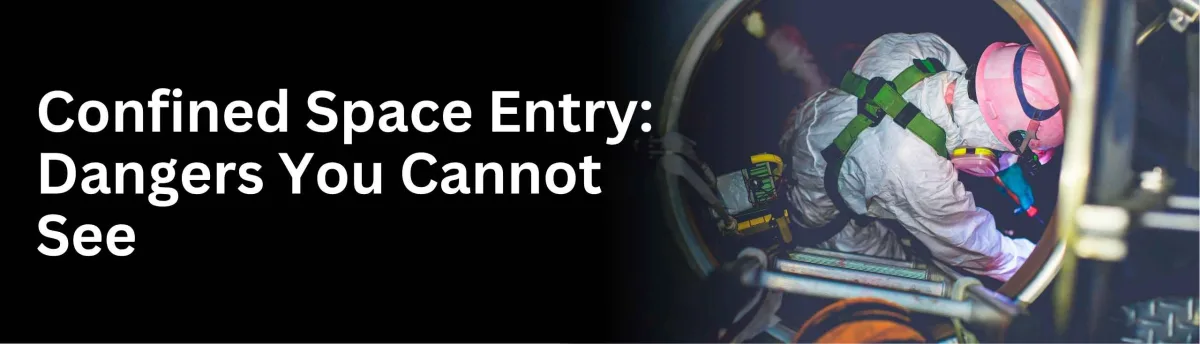
Look down into a manhole. Look into a storage tank. Look through the access port of a vessel that was operating an hour ago.
It looks like air. It smells like nothing. There is no visible sign that anything is wrong.
That is the problem.
The most dangerous thing about confined spaces is that dangerous conditions inside them may not be visible. Oxygen-deficient atmospheres can look exactly like normal air. Carbon monoxide is colorless and odorless. Hydrogen sulfide can have a rotten-egg smell at low concentrations, but higher concentrations can interfere with a person's sense of smell.
Flammable vapors can also collect inside tanks and other low areas without any visible indication that they are present.
Workers who enter confined spaces without atmospheric testing may not know what conditions exist inside.
OSHA defines a confined space as an area that:
Some confined spaces are also classified as permit-required confined spaces. These spaces have conditions that can create serious danger for workers, such as a hazardous atmosphere, the possibility of engulfment, an internal layout that could trap or injure a worker, or another serious safety or health hazard.
When workers enter a permit-required confined space, employers may need procedures covering entry permits, atmospheric testing, attendants, rescue procedures, and worker training.
You cannot always tell whether the air inside a confined space is safe by looking or smelling.
Atmospheric testing is used to check the conditions inside the space before workers enter and, when required, while they are inside.
Testing may check for:Conditions inside a confined space can change while work is taking place. A space that was safe when first tested may become unsafe because of nearby work, changing temperatures, chemicals, gases entering the space, or other changes.
That is why atmospheric testing is an important part of confined space entry procedures.
A worker enters a confined space and collapses. A coworker sees them go down and enters the space to help. The coworker collapses too. A third person follows. By the time the third person is incapacitated, the confined space that looked empty and harmless from the opening has taken two or three lives.
This is one of the most preventable patterns in confined space fatalities. It keeps happening because workers who see a coworker in distress may react on instinct instead of following the rescue procedure. The instinct to help is not wrong. The problem is entering a confined space without the training, equipment, and rescue plan needed to respond safely when a coworker collapses inside.
OSHA's confined space standard requires employers to have procedures for rescuing workers from permit-required confined spaces. Non-entry rescue is preferred when it can be performed without entering the space, and workers who perform rescue must have the required training and equipment. When atmospheric hazards are present, anyone who enters the space without the proper respiratory protection and rescue equipment can become a victim of the same hazard.
Call for help. Do not go in. This should be an automatic response when a worker collapses inside a confined space.
Confined spaces can contain different dangers depending on the location and the work being performed.
Common concerns include:A confined space may have more than one danger at the same time. Workers need to understand the conditions of the specific space before entering.
Confined space entry can involve several different roles.
Authorized EntrantsThese are workers who enter the confined space to perform their assigned work. They need to understand the dangers of the space, entry procedures, communication methods, and what to do if conditions become unsafe.
AttendantsAn attendant remains outside the confined space and monitors the workers inside. The attendant must understand their responsibilities, maintain communication with entrants, and take action according to the site's procedures if an emergency occurs.
Entry SupervisorsEntry supervisors are responsible for overseeing the entry operation. Their duties can include checking that entry procedures are followed, verifying required testing and equipment, and making sure the entry can be conducted safely.
Each role has different responsibilities, so training should match the worker's assigned duties.
Workers and supervisors can take confined space safety training online to learn about confined space entry procedures, common dangers, atmospheric testing, protective measures, and worker responsibilities.
Online training allows workers to complete their training at their own pace from a computer, tablet, or smartphone.
OSHA Training School offers online confined space-related training in English and Spanish. OSHA 10 and OSHA 30 training also include confined space topics as part of the course content.
Training can help workers understand what to look for before entering a confined space and why following entry procedures matters.
Workers should understand the entry procedures for the specific space and their assigned role before entering.
Depending on the space and the work, this may include:
The exact procedures depend on the workplace, the type of confined space, and the work being performed.
The opening of a confined space may tell you very little about what is happening inside.
The air may look normal. The walls may look stable. There may be no smell.
None of these things alone tells you that the space is safe to enter.
Before entering a confined space, workers need to understand the space, know the entry procedures, and follow the required precautions.
What you cannot see inside a confined space can be just as important as what you can see.
Trusted by thousands of workers & supervisors