
Posted On: November 06, 2026
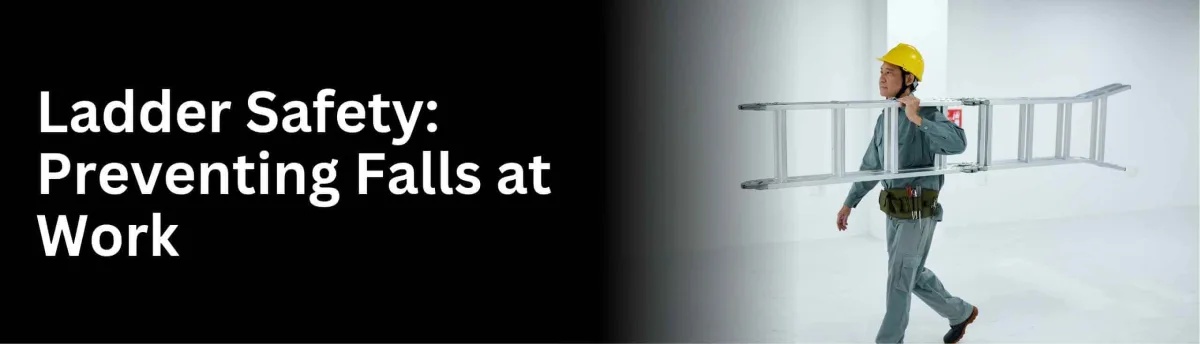
A worker needed to reach a section of wall above a doorway. A ladder was nearby, so he opened it, climbed a few steps, and began working.
But the floor was uneven. The ladder shifted slightly, causing the worker to lose his balance and fall.
A task that should have taken only a few minutes ended in a serious injury.
Ladder falls can happen during routine work. Workers may use ladders every day and become comfortable with them, but regular use does not remove the risks. A ladder must be in good condition, placed on a stable and level surface, and used correctly to help prevent falls.
Ladder falls are not always caused by damaged equipment. Many incidents happen because a ladder is not positioned correctly or is used in an unsafe way.
A ladder can shift when placed on an unstable surface. A worker may lose balance by reaching too far to one side, or lose their grip while climbing with tools in their hands. Even a ladder in good condition can cause a fall if it is not used correctly.
Other conditions that can lead to ladder falls include:
A ladder may appear to be in good condition and still be unsafe for the task. Workers should inspect the ladder, check the surface where it will be placed, and confirm that it is positioned securely before climbing.
Not every ladder is suitable for every task. Workers should select a ladder designed for the type of work and capable of supporting the combined weight of the worker, tools, and materials.
The ladder's rated capacity must not be exceeded. Workers should also consider the ladder's height, material, and suitability for the work environment.
For example, a metal ladder should not be used where it could contact exposed energized electrical equipment. Under OSHA's construction ladder standard, portable ladders must have nonconductive side rails when they could contact exposed energized electrical equipment, subject to specified exceptions.
Using the right ladder allows workers to reach the work area safely without relying on unstable positions or makeshift arrangements.
A ladder's placement is just as important as its condition.
Before climbing, workers should check the surface and surrounding area. Ladders must be placed on stable and level surfaces unless they are secured to prevent accidental movement. If workplace traffic or other activities could displace a ladder, it must be secured or protected with a barricade.
For a non-self-supporting ladder, such as a straight or extension ladder, OSHA requires it to be positioned at an angle where the horizontal distance from the top support to the foot of the ladder is approximately one-quarter of its working length. This is known as the 4-to-1 rule.
When a portable ladder is used to access an upper landing, its side rails must extend at least 3 feet above the landing. If this extension is not possible because of the ladder's length, the ladder must be secured at the top to a rigid support that will not deflect. A grasping device, such as a grab rail, must also be provided to help workers get on and off the ladder.
Once the ladder is set up, workers must still use it correctly.
OSHA's construction standard requires workers to face the ladder when climbing up or down and use at least one hand to grasp it while moving. Workers should not carry objects that could cause them to lose balance.
A few practical steps can help reduce the risk of falling:
If a task requires reaching beyond a safe position, the worker should climb down and reposition the ladder rather than stretching to reach the work.
A ladder should be checked before it is used. Workers should look for broken or missing steps, cracked rails, loose parts, corrosion, and other damage that could affect its safe use.
OSHA requires construction ladders to be inspected by a competent person for visible defects and after any event that could affect their safe use. Portable ladders with structural defects must be marked or tagged as defective and removed from service until repaired.
A damaged ladder should not be used just because the task is short. It should be taken out of service and handled according to workplace procedures.
OSHA's construction ladder requirements are covered under 29 CFR 1926.1053. The standard addresses ladder design, use, inspection, and safe positioning.
Among its requirements:
For general industry workplaces, ladder requirements are covered under 29 CFR 1910.23. Employers must ensure that ladders used in their workplaces meet the requirements of that standard.
OSHA construction and general industry training includes topics related to falls, walking and working surfaces, and safe work practices. These topics help workers understand how unsafe ladder use can lead to injuries and why equipment must be selected, inspected, and used correctly.
OSHA 10 and OSHA 30 training provide broader workplace safety knowledge. They do not replace task-specific training or any additional requirements that apply to the equipment or work being performed.
OSHA Training School offers OSHA 10 and OSHA 30 courses online in English and Spanish. The courses are self-paced and can be accessed from any device.
Ladder safety begins before a worker climbs. Choosing the right ladder, checking its condition, placing it on a stable surface, and using it correctly can help prevent falls.
Workers should never assume that a ladder is safe simply because it has been used before. Each task and work area can present different conditions.
Taking a few moments to check the ladder can prevent an injury that changes a worker's life.
Trusted by thousands of workers & supervisors