
Posted On: August 07, 2026
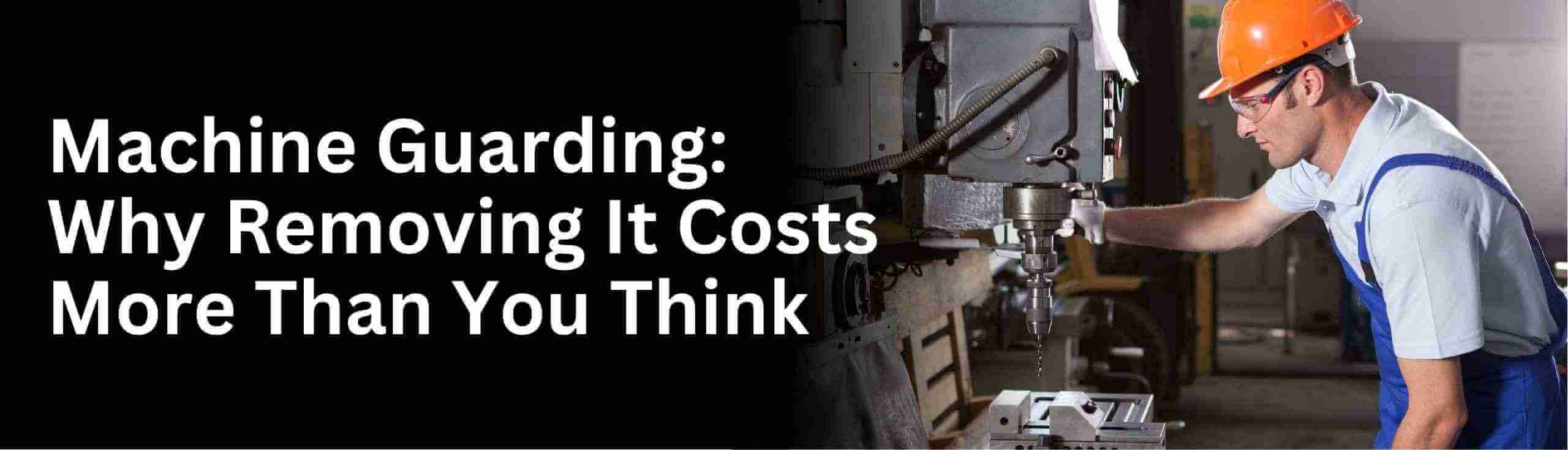
Machine guarding is one of the most important safety measures in manufacturing and industrial workplaces, yet it is often overlooked. A machine guard gets in the way. It slows production. Someone removes it to speed up the job. Nobody says anything. The guard stays off. Days pass. Weeks pass. And then one morning, everything changes.
Machine guarding violations are consistently among the top ten most cited OSHA standards every year. Not because employers are reckless, but because the dangers associated with unguarded machinery are easy to overlook until an injury occurs. In a matter of seconds, a worker can suffer an amputation, crush injury, fracture, or other life-changing injury that could have been prevented by a properly installed guard.
Machine guarding refers to physical barriers and safety devices installed on machinery to protect workers from moving parts, rotating components, flying debris, sparks, and other mechanical hazards during normal operation.
OSHA's Machine Guarding standard, 29 CFR 1910.212, requires machines with moving parts that could cause injury to be properly guarded. This applies to point-of-operation hazards where material is cut, shaped, bored, or formed, as well as power transmission components, including belts, pulleys, chains, gears, and rotating shafts.
The reason this standard exists is simple. A rotating shaft may not seem dangerous until a worker's sleeve gets caught in it. A punch press may not seem dangerous until a worker's hand is in the wrong place at the wrong time. Machine guarding helps prevent those mistakes from resulting in serious injuries.
The injuries caused by unguarded machinery are among the most severe in any workplace. Amputations, crush injuries, fractures, lacerations, and avulsion injuries, where skin and tissue are torn from the body, can occur in seconds and usually result in permanent damage.
The United States Bureau of Labor Statistics reports thousands of workplace amputations each year, with manufacturing accounting for the largest share. Many of these incidents involve machinery that was either unguarded or had its guard removed.
These are not random accidents. They are the result of workers being exposed to hazardous moving parts without proper protection. A single moment of contact with an unguarded machine can lead to a life-changing injury.
Machine guarding training teaches workers how to identify mechanical hazards on the machines they work with every day, understand the types of guards required for different machines, inspect guards before starting a shift, recognize when a guard is missing or damaged, and understand why bypassing or removing a guard, even temporarily, can create serious safety risks.
Any worker who operates, maintains, or works near machinery with exposed moving parts should receive machine guarding training. This includes press operators, lathe operators, grinder operators, conveyor workers, woodworking machine operators, and other employees who work around machinery in manufacturing and industrial facilities.
Supervisors and safety managers should have a deeper understanding of machine guarding requirements so they can identify hazards, correct deficiencies, and help prevent machinery from operating without proper guards in place.
Machine guarding training is available online through OSHA Training School in English and Spanish as part of the OSHA 10 and OSHA 30 General Industry courses. Both courses are self-paced and can be completed from any device.
Group pricing is available for employers training 10 or more workers.
Machine guarding is one of the most important topics covered in OSHA 10/30 General Industry training. OSHA training helps workers identify mechanical hazards, understand guarding requirements, and follow safe work practices around machinery. Whether you are training for yourself or providing training for an entire workforce, OSHA training can help create a safer workplace.
Trusted by thousands of workers & supervisors