
Posted On: May 05, 2026
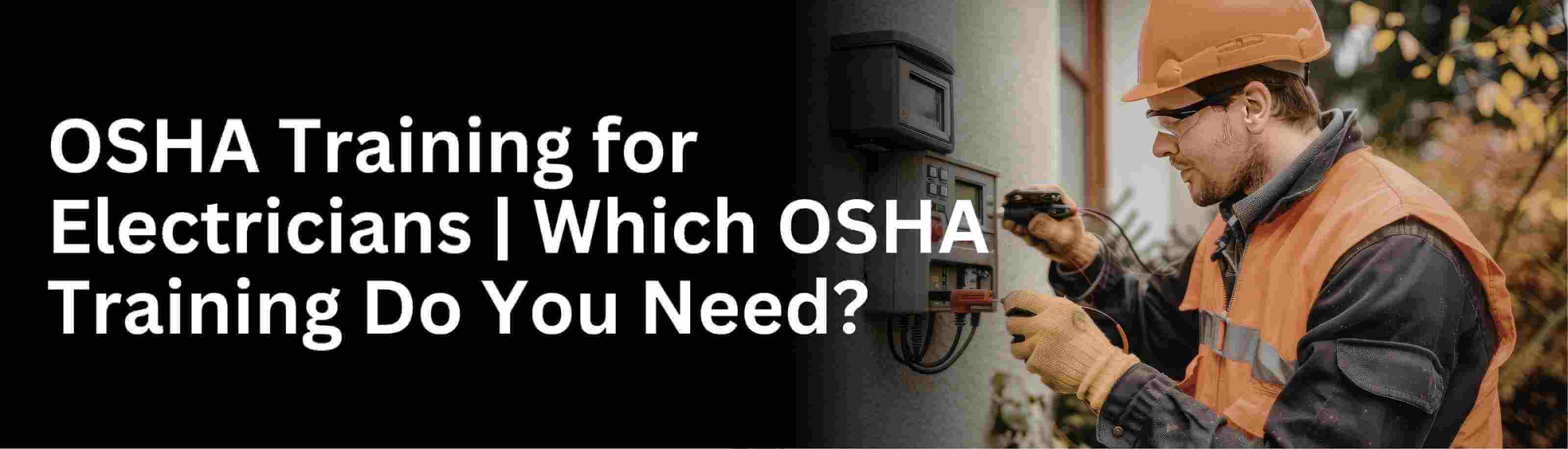
Electricians completing safety training usually ask which course fits their role, and it is an important question. Electrical work involves some of the most dangerous hazards on any job site. A fall may give you a second to react. An electrical mistake usually does not.
Every year, hundreds of electricians suffer serious injuries or lose their lives from electrocution, arc flash incidents, and working near energized equipment without proper precautions. Because of these risks, electrical work is one of the most heavily regulated trades in both construction and general industry.
Whether you are a first-year apprentice, a journeyman electrician, or a master electrician managing your own crew, knowing which OSHA electrical safety training applies to your role and how to complete it without disrupting your schedule can make the difference between site access and being turned away.
OSHA has specific standards that apply directly to electrical work. The construction electrical standard (29 CFR 1926 Subpart K) covers working near live circuits, lockout/tagout procedures, and required PPE. The general industry standard (29 CFR 1910 Subpart S) applies to facility and plant electricians.
Federal OSHA law does not mandate that every electrician complete OSHA 10 or OSHA 30 outreach training. However, most general contractors, commercial project owners, and electrical contractors require documented training before granting site access.
In many cases, no OSHA training means no entry on commercial or government projects. Employers require it to confirm that workers understand hazard recognition, safe work practices, and their responsibilities under electrical safety standards.
If you are an electrician doing hands-on work, whether you are an apprentice, journeyman, or working under a licensed master electrician, OSHA 10 Hour Construction is the standard course for your role.
The course covers the hazards electricians face every day, including electrical safety around live circuits, lockout/tagout procedures, fall protection from ladders and scaffolds, struck-by and caught-in hazards, fire prevention, and workers' rights on job sites.
If you manage a crew of electricians, run electrical subcontracting work, or oversee job site safety for electrical operations, OSHA 30 is the right course for your role.
OSHA 30 goes beyond basic hazard recognition and covers the full scope of running a safe electrical operation. You will learn how to manage safety programs, conduct site inspections, understand OSHA standards in depth, handle recordkeeping requirements, and lead a crew that works safely around energized equipment every day.
OSHA 10 takes 10 hours to complete and OSHA 30 takes 30 hours. Both are fully online and self-paced, so you can train from your phone or laptop, stop and start anytime, and pick back up exactly where you left off. Most students complete OSHA 10 in two to three days and OSHA 30 in five to seven days.
OSHA training covers electrical safety broadly, but if you regularly work around energized electrical equipment, NFPA 70E is something every electrician should understand.
NFPA 70E is the Standard for Electrical Safety in the Workplace published by the National Fire Protection Association (NFPA). It focuses on topics such as arc flash hazards, safe approach distances, arc flash risk assessments, and choosing the proper arc-rated personal protective equipment (PPE).
Many employers use NFPA 70E training to help protect workers from arc flash hazards, and it is recognized as an important electrical safety standard. Because of this, many electrical contractors and industrial facilities require workers to complete NFPA 70E training along with OSHA training.
If your work involves installing or maintaining electrical panels or working near energized equipment, understanding NFPA 70E can help you work more safely and reduce the risk of serious electrical injuries.
No. OSHA 10 and OSHA 30 are outreach training courses that cover broad construction and general industry safety. NFPA 70E is a separate electrical safety standard focused specifically on arc flash hazards and energized electrical work. Many electricians benefit from completing both
Yes. For most working electricians, online training is the most convenient option. You are on job sites during the day, and classroom training usually means time away from work.
OSHA Training School offers OSHA 10, OSHA 30, and NFPA 70E courses that are fully online, self-paced, and available 24 hours a day. You can train in the evening, during a slow week, or on weekends.
Courses are available in both English and Spanish and are offered through OSHA-authorized providers such as UL Solutions and HSI, meaning the training is accepted on job sites across the United States.
For OSHA 10 and OSHA 30, you will receive a printable certificate of completion immediately upon completing. Your official OSHA DOL wallet card will then be mailed to you within four to six weeks.
For NFPA 70E, you will receive a certificate of completion upon finishing.
If you run an electrical contracting business and need to get your entire crew trained, OSHA Training School makes it simple. Group pricing is available for employers training ten or more workers, and you get access to a free Learning Management System to assign courses, track completions, and download certificates from one central account.
Getting your crew trained before a project starts, rather than scrambling after a general contractor requires it, saves you time, money, and the headache of pulling workers off site.
Whether you're just starting out or managing a crew, we have the right course for you. Our OSHA 10, OSHA 30, and NFPA 70E courses cover both Construction and General Industry, fully online, self-paced, and accepted on job sites across the United States. No classroom, no fixed schedule. Learn at your own pace, on your own time.
OSHA 10 - $50 A great starting point for workers. Covers the hazards you actually face on the job and what to do about them.
OSHA 30 - $135 Designed for supervisors and lead workers who need a deeper understanding of safety management and compliance.
NFPA 70E - $29.99 For anyone working on or near energized equipment. Covers arc flash, shock hazards, and the safety practices that protect you and everyone around you.
Training a whole crew? We offer group pricing for contractors. Contact us and we'll find the best deal that works for your team and budget.
Trusted by thousands of workers & supervisors